C6 vs C0 Water Repellent: How to Choose (and Where C8 Fits)
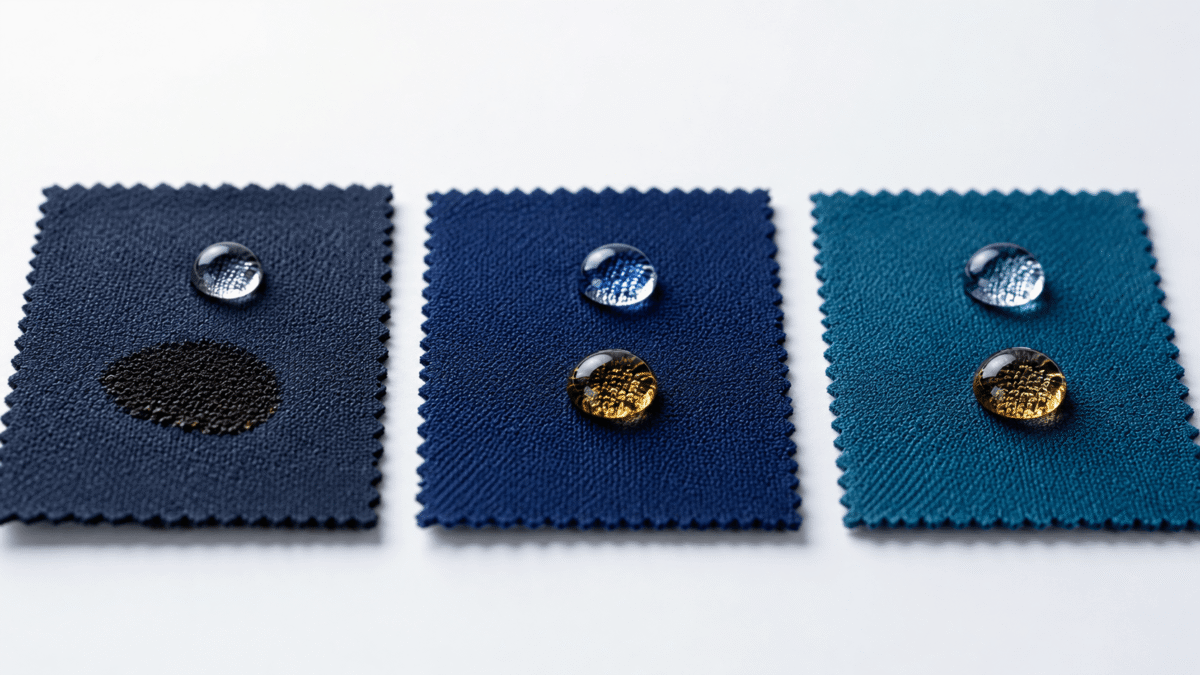
Choosing a C6 vs C0 water repellent comes down to one thing: fluorine. C0 repellents are completely fluorine-free (PFAS-free) and repel water only; C6 — and the legacy C8 — are fluorocarbon chemistries that repel both water and oil, but they contain PFAS. This guide compares how each performs, where each fits, and how to choose the right chemistry for your fabric and market.
New to the topic? Start with our overview of durable water repellent (DWR) finishes, then come back here to compare the chemistries.
C0 vs C6 vs C8 at a glance
| Property | C0 — Fluorine-free | C6 — Short-chain | C8 — Long-chain (legacy) |
|---|---|---|---|
| Water repellency | Excellent | Excellent | Excellent |
| Oil / stain repellency | None | Good | Excellent |
| PFAS status | PFAS-free | Contains PFAS (PFOA-free) | PFAS (PFOA/PFOS-based) |
| Wash durability* | Good–very good | Very good | Excellent |
| Typical cost | $–$$ | $$$ | $$$ (restricted) |
| Regulatory outlook | Compliant everywhere | Under increasing restriction | Banned / phased out |
| Best for | PFAS-free apparel, filtration, consumer sprays | Water + oil where PFAS is still allowed | Legacy only — avoid |
*With a proper crosslinker and heat cure. Durability depends far more on application than on chemistry alone.
What is a C0 (fluorine-free) water repellent?
C0 means zero fluorine. These finishes are built on silicone, hydrocarbon, dendrimer or modified-polymer chemistry instead of fluorocarbons. Because they contain no PFAS, they satisfy every current and proposed PFAS restriction — which is why C0 has become the default for apparel brands, technical textiles and consumer sprays sold into regulated markets.
The trade-off: a fluorine-free finish repels water, mud and water-based stains, but it cannot repel oil. Oil and grease have a low surface tension that only fluorochemistry can beat. If your specification is water repellency only, a modern C0 — applied with the right crosslinker and cure — delivers a high spray rating and solid wash durability with a soft hand.
Best for: PFAS-free requirements, apparel (jackets, sportswear, kidswear), filtration and technical textiles, and Scotchgard-style consumer sprays.
What is a C6 (short-chain fluorocarbon) water repellent?
C6 chemistry uses a six-carbon fluorotelomer backbone. It repels both water and oil/stains, and unlike the older C8 it does not break down into PFOA — which is why the industry migrated from C8 to C6 in the 2010s. C6 gives you the dual water-and-oil performance that fluorine-free products can’t match, with strong wash durability.
The catch: C6 is still a PFAS. It contains fluorine, and as regulators shift from banning individual substances (like PFOA) toward restricting PFAS as a whole class, C6 faces tightening scrutiny — especially in the EU and several US states. It remains widely used where oil repellency is essential and PFAS is still permitted.
Best for: workwear, industrial fabrics and some outdoor gear that genuinely need oil/stain repellency, in markets where PFAS is still allowed.
What is a C8 water repellent — and why it’s being phased out?
C8 is the original long-chain fluorocarbon chemistry. It offers the best water and oil repellency and the highest durability of the three — but it is based on, or degrades into, PFOA and PFOS, which are persistent, bioaccumulative and toxic. PFOA is listed under the Stockholm Convention and restricted across the EU, US and beyond. C8 is now effectively obsolete for new textile programs. If a supplier still pushes C8, treat it as a red flag for anything headed to a regulated market.
The key difference: water repellency vs oil repellency
This is the single most important thing to understand: repelling oil requires fluorine.
- Water repellency — achievable with C0, C6 or C8.
- Oil / stain repellency — only C6 or C8 (fluorochemistry).
So the real decision isn’t “which is best” in the abstract — it’s two questions: Do I need oil repellency? And can my market accept PFAS? Answer those and the chemistry chooses itself.
PFAS and regulations: what “PFAS-free” really means
“PFAS-free” means no per- and polyfluoroalkyl substances at all — which in practice means fluorine-free, i.e. C0. A product can be “PFOA-free” (like C6) while still being a PFAS. As regulation moves from single-substance bans toward whole-class restrictions — the EU’s proposed universal PFAS restriction, US state textile laws such as California’s — brands are increasingly specifying true fluorine-free C0 to future-proof their lines and avoid re-qualifying a finish every time the rules tighten.
Durability and application
None of these chemistries is durable on its own. Wash durability comes from how the finish is applied: a crosslinker plus a proper heat cure (typically 150–170 °C on a stenter) bonds the repellent to the fibre so it survives repeated laundering. Spray-on, air-dry consumer grades trade some durability for convenience — no oven required — and are formulated differently. The chemistry sets the ceiling; the application decides whether you reach it.
How to choose your C6 vs C0 water repellent
- Choose C0 (fluorine-free) if you sell into the EU/US or other regulated markets, your brand is PFAS-free, or you only need water repellency — which covers most apparel, filtration and consumer sprays.
- Choose C6 if you genuinely need oil/stain repellency (workwear, industrial) and your market still permits PFAS.
- Avoid C8 — legacy, restricted, not viable for new programs.
Then match the details to your line: substrate (some fibres need a low-temperature cure), application method (pad-dry-cure vs spray-on), required wash cycles, and hand-feel.
Get the right grade for your fabric
DWR Factory supplies the full range — water-based and solvent-based C0 (fluorine-free), C6 fluorocarbon, and spray-on / air-dry grades for consumer aftercare — with OEKO-TEX and ZDHC-compliant options and a TDS/SDS for every grade. Still weighing a C6 vs C0 water repellent for your line? Send us your fabric and target spray rating and we’ll recommend a grade — with a free sample. Or browse our product range.
Frequently asked questions
Is C6 a PFAS?
Yes. C6 is a short-chain fluorocarbon; it is PFOA-free, but it still contains fluorine and is classed as a PFAS. Only fluorine-free C0 is genuinely PFAS-free.
Is C0 completely PFAS-free?
Yes. C0 contains no fluorine, so it meets PFAS-free requirements and complies with current and proposed PFAS restrictions.
Can a C0 water repellent repel oil?
No. Oil repellency requires fluorochemistry (C6 or C8). C0 repels water and water-based stains only. If you need to repel oil and grease, you need a fluorocarbon finish.
Is C8 banned?
C8 is based on — or degrades into — PFOA, which is restricted under the Stockholm Convention and many national regulations. It is effectively phased out for textile finishing.
Which chemistry lasts the most washes?
With a proper crosslinker and cure, C6 and C8 are marginally more durable, but a well-applied modern C0 achieves strong wash durability — often 20+ cycles — for water repellency.
Does fluorine-free mean lower performance?
For water repellency, no — modern C0 matches fluorocarbons on spray rating and hand-feel. The only thing a fluorine-free finish cannot do is repel oil.
Explore our water repellents
Need help choosing a water repellent?
Tell us your substrate, process and target. Our technical team will recommend a grade, send the datasheet, and arrange a free sample.