Durable Water Repellent (DWR) Agents: Complete Guide
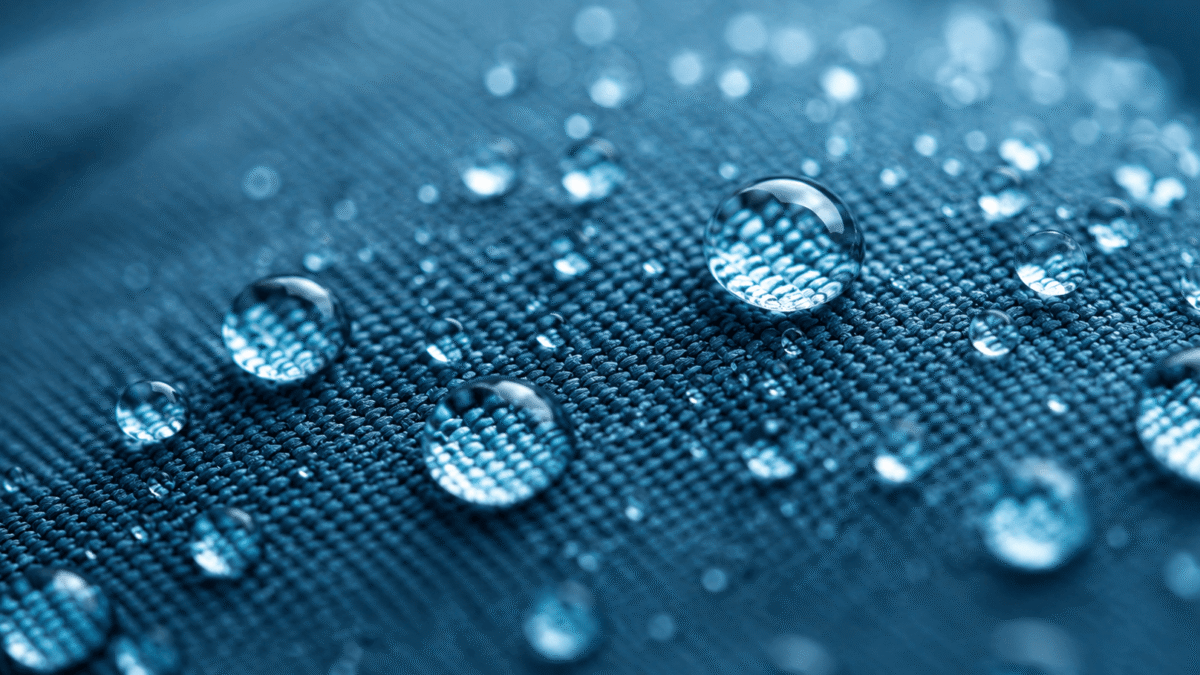
Everything textile finishers, formulators, and sourcing teams need to know about C0, C6 and C8 water repellents: how they work, how they differ, and how to choose the right one for your fabric.
Key takeaways
- A durable water repellent (DWR) makes water bead and roll off a fabric. It is not the same as a waterproof membrane, and the fabric stays breathable.
- Fluorine-free (C0) agents repel water only. Oil and stain repellency requires fluorocarbon (C6 or C8) chemistry.
- C6 and C8 are PFAS. C0 is the PFAS-free choice, driven by OEKO-TEX, ZDHC and tightening regulations.
- Wash durability comes from a crosslinker plus a heat cure (typically 150 to 170°C), not from the repellent alone.
- Water-based agents suit most mill finishing and ship easily; solvent-based agents suit leather and footwear.
What is a durable water repellent (DWR)?
A durable water repellent (DWR) is a chemical finish applied to a fabric so that water beads up and rolls off the surface instead of soaking in. “Durable” means the finish is designed to survive repeated washing and wear. It is not the same as “waterproof”.
A DWR works at the surface of the fibre. It lowers the surface energy of the fabric so that water cannot spread and wet it, forming droplets that run off instead. Because it only treats the fibre surface, the fabric stays breathable and keeps its normal hand feel.
This is the key difference from waterproof: a waterproof fabric uses a membrane or a continuous coating to form a complete barrier that blocks water entirely, but is not breathable. A DWR repels water while letting air and moisture vapour pass through, which is why it is used on outdoor apparel, sportswear, tents, umbrellas, footwear, filtration media and technical textiles.
C0 vs C6 vs C8: which water repellent chemistry?
The three families differ by fluorine content. C0 is fluorine-free and repels water only. C6 and C8 are fluorocarbon chemistries that repel water and oil, but they are PFAS. C8 (long-chain) is largely phased out, C6 (short-chain) is the current fluorinated option, and C0 is the PFAS-free choice.
| Chemistry | Water repellency | Oil / stain repellency | PFAS? | Typical use |
|---|---|---|---|---|
| C0 — Fluorine-free | Yes | No | PFAS-free | Brands with strict PFAS-free, OEKO-TEX or ZDHC requirements |
| C6 — Short-chain fluorocarbon | Yes | Yes (moderate) | Yes | Outdoor apparel and workwear needing water + oil/stain resistance |
| C8 — Long-chain fluorocarbon | Yes | Yes (highest) | Yes | Demanding industrial uses; largely restricted and phased out |
The single most important thing to remember: fluorine is what delivers oil repellency. Remove the fluorine (C0) and you keep water repellency but lose the ability to repel oil. The market has been moving from C8 to C6 to C0 as regulations on PFAS (“forever chemicals”) tighten, especially in the EU and parts of North America.
Does fluorine-free (C0) repel oil?
No. A fluorine-free (C0) water repellent repels water but not oil or oil-based stains. Oil and stain repellency (oleophobicity) can only be achieved with fluorocarbon chemistry (C6 or C8). If a fabric must be both oil-repellent and PFAS-free, that is not achievable with today’s C0 chemistry.
Water repellency (hydrophobicity) and oil repellency (oleophobicity) are two different properties. Repelling water requires lowering the fabric’s surface energy below that of water. Repelling oil requires lowering it much further, below the surface energy of oils, and only fluorine chemistry reaches that level. This is why a C0 finish can score well on a water spray test but offer little resistance to oily stains.
In practice this shapes the choice: if a buyer needs protection from rain, splashes and water-based dirt, C0 is an excellent PFAS-free option. If they need to shrug off cooking oil, grease and food stains, they need a C6 grade and must accept that it is a fluorinated (PFAS) product.
Water-based vs solvent-based water repellents
Water-based agents are the standard for textile mill finishing: low odour, easy to handle, and generally non-hazardous to ship. Solvent-based agents penetrate faster and dry quickly, which suits leather, suede and footwear, but they are flammable and ship as dangerous goods.
- Water-based: environmentally friendlier, low odour, usually non-hazardous for transport, and the norm for pad-dry-cure lines on woven and knit fabric.
- Solvent-based: stronger penetration and fast drying, preferred for leather, suede, shoe uppers and substrates that do not absorb water well. Because the solvent is flammable, it is classed as dangerous goods, which affects packaging and freight.
How is DWR applied to fabric?
The most common method is pad-dry-cure on a stenter: the fabric is padded through a bath of diluted agent, squeezed between rollers, dried, then cured at high temperature. Yarn is treated by exhaust (immersion), and finished garments or footwear are treated by spray-on, air-dry consumer products.
- Pad-dry-cure (padding): the standard continuous mill process for woven and knit fabric. Concentration is set in grams per litre of bath, followed by drying and a high-temperature cure.
- Exhaust (immersion): the goods are immersed and the agent is absorbed onto the fibre, typically used for yarn or in dyeing machines.
- Spray-on / air-dry: a consumer or aftercare route where a trigger spray is applied to a finished garment or shoe and left to air-dry, with no heat cure. It is convenient but less wash-durable than a cured mill finish.
How do you make water repellency wash-durable?
Wash durability comes from adding a crosslinker to the repellent and curing at high temperature, typically 150 to 170°C. The crosslinker anchors the repellent to the fibre so it survives repeated laundering. The repellent on its own gives good initial water beading but limited wash durability.
Think of it as three parts working together. The repellent delivers the water-beading effect. The crosslinker acts like an anchor that binds the repellent to the fibre. The heat cure is what activates the crosslinker; without enough temperature the crosslinker does not react and the finish washes off. This is why cure temperature is so important to a durable result.
Dosage matters too. Too little crosslinker and the finish is not durable enough; too much can stiffen the hand feel and add cost. The right starting recipe is refined through lab trials on the specific fabric to hit a wash-durability target, for example maintaining a high spray rating after 10, 20 and 30 washes.
How is water repellency measured?
Water repellency is measured by the spray test, AATCC 22 (or ISO 4920), rated 0 to 100 where higher is better. Oil repellency is measured by AATCC 118, graded 1 to 8. Wash durability is reported as the spray rating retained after a set number of home launderings.
- AATCC 22 / ISO 4920 (spray test): water is sprayed onto the fabric and the wetting pattern is scored from 0 to 100. This is the most common water-repellency rating in specifications.
- AATCC 118 (oil repellency): a series of test oils is applied and the fabric is graded 1 to 8. Only fluorinated finishes reach the higher grades.
- Wash durability: the spray rating is re-measured after a defined number of wash cycles, so a spec might read “spray rating 100 initial, 90 after 10 washes, 80 after 20 and 30 washes”.
Note that a spray rating is not the same as a hydrostatic head (water pressure) figure. Hydrostatic head describes waterproof membranes and coatings, a different property from surface water repellency.
Certifications and compliance
The certifications buyers most often ask for are OEKO-TEX Standard 100 (product safety), ZDHC MRSL (restricted substances in manufacturing), and a PFAS-free declaration for C0 products. EU REACH compliance is also standard.
- OEKO-TEX Standard 100: confirms the product is free of harmful substances, a baseline for textile safety.
- ZDHC MRSL: a manufacturing restricted substances list required across many major brand supply chains.
- PFAS-free declaration / test report: the proof point for a fluorine-free (C0) product.
- EU REACH: compliance with the EU chemical regulation, expected for export to Europe.
How to choose the right water repellent
Start from two questions: do you need oil repellency as well as water, and do you have a PFAS-free requirement? Those two answers point you to a chemistry. For the full breakdown, see our guide to choosing a C6 vs C0 water repellent (and where C8 fits). Then match the carrier to your substrate and set a wash-durability target.
- Need PFAS-free and only water repellency (OEKO-TEX / ZDHC brands): choose C0.
- Need water plus oil / stain repellency: choose C6, and accept that it is a fluorinated (PFAS) product.
- Highest oil repellency for industrial use: C8, where still permitted.
- Leather, suede or footwear: a solvent-based grade usually performs best.
- Wash durability target: plan for a crosslinker and a high-temperature cure.
Frequently asked questions
Is a durable water repellent the same as waterproof?
No. A DWR treats the fibre surface so water beads and rolls off while the fabric stays breathable. Waterproof means a full barrier, such as a membrane or coating, that blocks water completely and is not breathable.
Can a fluorine-free (C0) water repellent repel oil?
No. Fluorine-free (C0) agents repel water only. Oil and oil-based stain repellency requires fluorocarbon chemistry (C6 or C8). If a project must be PFAS-free, oil repellency is not achievable with current C0 chemistry.
What do C0, C6 and C8 mean?
They describe fluorine content. C0 is fluorine-free (PFAS-free) and repels water only. C6 and C8 are fluorocarbon chemistries that repel water and oil but are PFAS; C8 is largely phased out and C6 is the current fluorinated option.
How do you make water repellency survive washing?
Wash durability comes from adding a crosslinker and curing at high temperature, typically 150 to 170°C. The crosslinker anchors the repellent to the fibre so it survives repeated laundering.
How is water repellency measured?
Water repellency is measured by the spray test AATCC 22 or ISO 4920, rated 0 to 100. Oil repellency is measured by AATCC 118, graded 1 to 8. Wash durability is reported as the spray rating retained after a set number of home launderings.
Which water repellent is best for footwear and leather?
Solvent-based agents are generally preferred for leather, suede and footwear because they penetrate faster and dry quickly. Water-based agents are the standard for textile mill finishing.
Related guides
- C6 vs C0 vs C8 water repellents — how the chemistries differ and how to choose.
- PFAS-free water repellents — a guide for brands facing PFAS bans.
- How to apply a durable water repellent — pad-dry-cure, exhaust and spray-on methods.
- Water repellency ratings explained — AATCC 22, ISO 4920 and oil repellency.
- Wash-durable water repellency — crosslinkers, curing and how many washes.
Explore our water repellents
Need help choosing a water repellent?
Tell us your substrate, process and target. Our technical team will recommend a grade, send the datasheet, and arrange a free sample.