Water Repellency Ratings Explained: AATCC 22, ISO 4920 & Oil
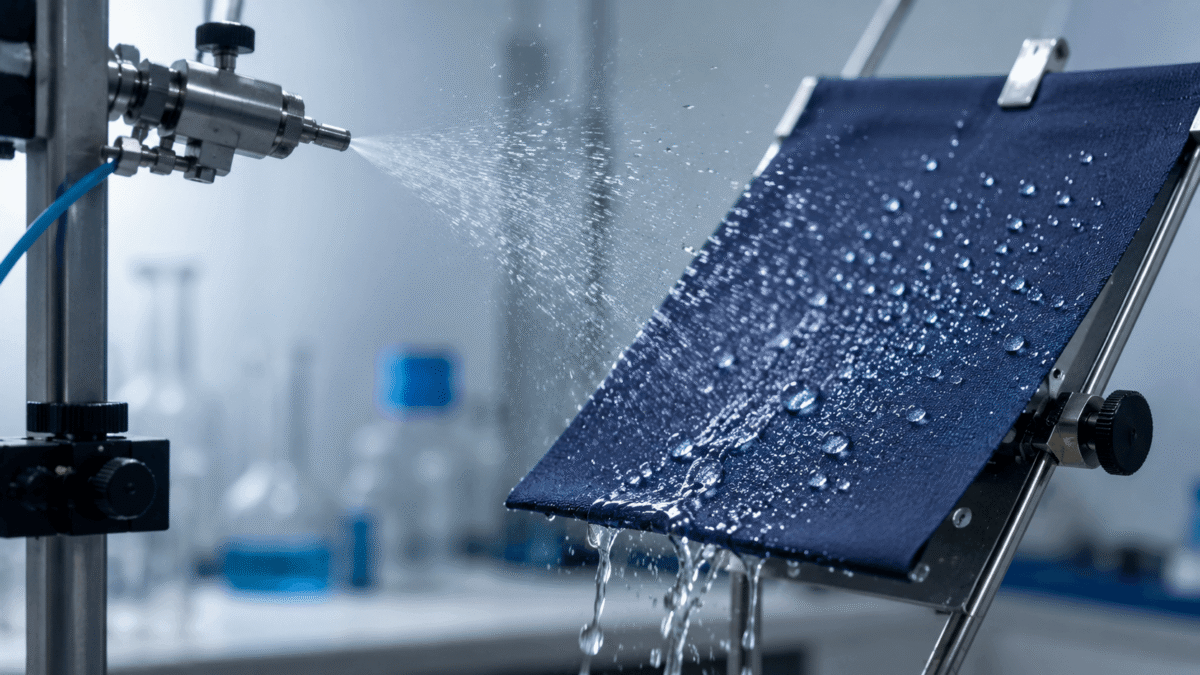
Water repellency ratings tell you how well a finish repels water: the higher the number, the better the fabric beads up and sheds it. The most common is the AATCC 22 / ISO 4920 spray test, scored 0–100, while oil repellency uses a separate AATCC 118 scale of 1–8. This guide explains what each water repellency rating means, how the tests work, and what score to aim for.
For background, see our durable water repellent overview; to understand why oil ratings behave differently, see C6 vs C0 water repellents.
What water repellency ratings measure
A water repellency rating measures surface repellency — how well water beads and rolls off the face of the fabric — not whether water can be forced through it under pressure. That second property, waterproofness, is measured separately as hydrostatic head. A fabric can have a high spray rating and still let water through under pressure, and the reverse is also true.
The spray test: AATCC 22 and ISO 4920 (0–100)
The spray test is the industry standard. A measured volume of water is sprayed onto fabric held at 45°, and the wetted pattern is compared against a photographic scale:
| Rating | What it means |
|---|---|
| 100 | No wetting or sticking of water on the surface |
| 90 | Slight random sticking or wetting |
| 80 | Wetting of the surface at the spray points |
| 70 | Partial wetting of the whole surface |
| 50 | Complete wetting of the whole surface |
| 0 | Complete wetting of the entire upper and lower surface |
AATCC 22 (American) and ISO 4920 (international) are essentially the same spray test and give comparable 0–100 scores, so a “spray rating of 90” means the same thing to buyers in either system.
Oil repellency ratings: AATCC 118 (1–8)
Oil repellency is a completely separate measurement. In AATCC 118, drops of test oils of decreasing surface tension are placed on the fabric; the rating (1–8) is the highest-numbered oil that does not wet the surface within a set time. Only fluorocarbon (C6/C8) finishes score on this scale — a fluorine-free C0 finish scores 0 for oil, because it repels water only.
Initial vs after-wash ratings
A single spray rating is only half the story. Durable finishes are quoted as an initial rating plus a retained rating after a number of home launderings — for example “100 initial, 80 after 20 washes”. Always check which one a supplier is quoting, and how durable that rating is (see wash durable water repellent). How the finish is applied decides how well it survives washing — see how to apply durable water repellent.
What score should you target?
- Everyday apparel: an initial spray rating of 80–90 is usually enough.
- Performance outerwear & technical textiles: aim for 90–100 initial, with a defined retained rating after 10–30 washes.
- Consumer aftercare sprays: a strong initial rating; durability is naturally lower than a cured finish.
Set both an initial and an after-wash target, so you’re specifying durability rather than just a fresh-off-the-line number.
Get grades with tested ratings
Every DWR Factory grade ships with a TDS stating its spray rating and, where relevant, its retained rating after washing and its AATCC 118 oil rating — measured, not estimated. Tell us your substrate and target and we’ll recommend a grade: request a free sample or browse the range.
Frequently asked questions
What is a good AATCC 22 spray rating?
80–90 is good for everyday apparel; aim for 90–100 for performance outerwear and technical textiles.
What does a spray rating of 100 mean?
No water wets or sticks to the surface — the highest result on the 0–100 spray-test scale.
What is the difference between AATCC 22 and ISO 4920?
They are essentially the same 0–100 spray test — AATCC 22 is the American method and ISO 4920 the international one, and their scores are comparable.
What is AATCC 118?
The oil repellency test, rated 1–8. Only fluorocarbon (C6/C8) finishes score, because oil repellency needs fluorine.
Is a water repellency rating the same as waterproof?
No. A water repellency rating measures surface beading (the spray test); waterproofness is measured separately as hydrostatic head.
How is wash durability rated?
As a retained spray rating after a set number of home launderings — for example AATCC 22 measured again after 20 washes.
Explore our water repellents
Need help choosing a water repellent?
Tell us your substrate, process and target. Our technical team will recommend a grade, send the datasheet, and arrange a free sample.